
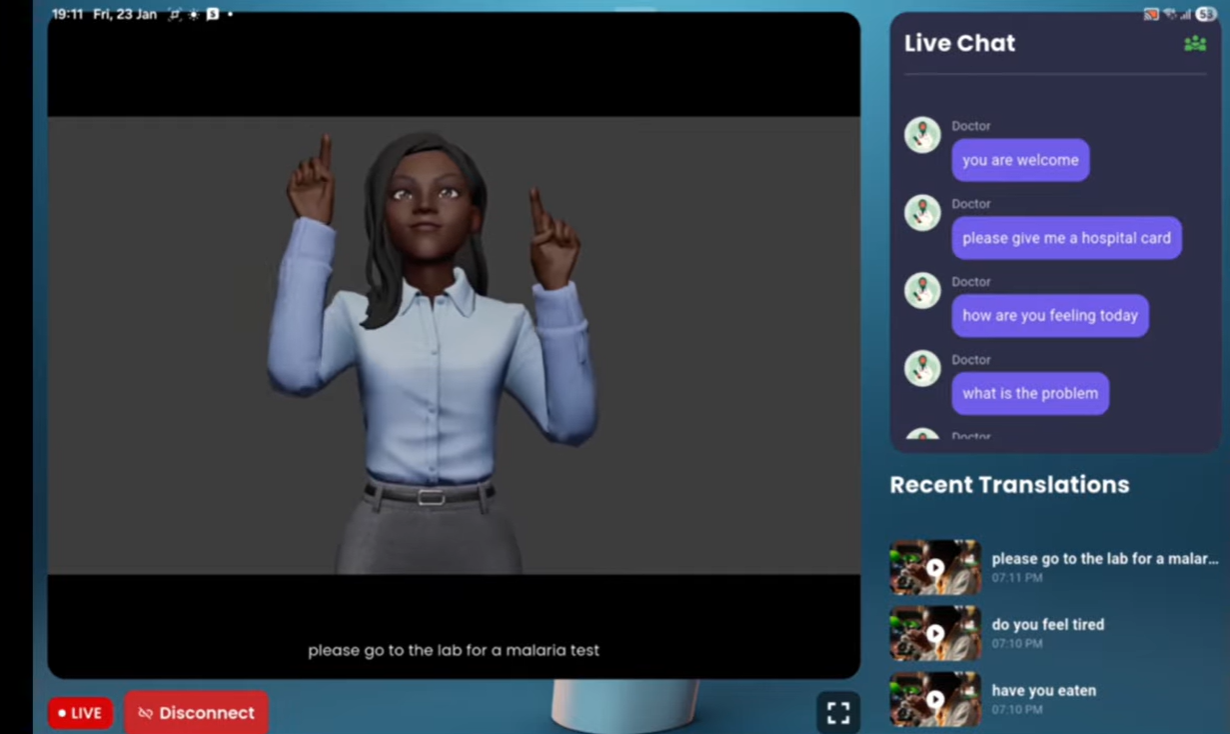
Researchers at the Kwame Nkrumah University of Science and Technology, Kumasi (KNUST) have developed an artificial intelligence-powered system to improve communication between Ghanaian Sign Language users and healthcare professionals who do not understand sign language.
The system, known as SignTalk-Gh, is designed to address communication barriers faced by Deaf and hard-of-hearing patients, particularly during medical consultations.
Lead researcher Dr Emmanuel Ahene, a Senior Lecturer at the Department of Computer Science, KNUST, said the system was developed to help patients communicate their symptoms and better understand medical information.
“For many speech and hearing-impaired people, communication can become a significant barrier to accessing health care and SignTalk is using artificial intelligence to bridge this communication gap,” he said.
Dr Ahene said SignTalk-Gh uses artificial intelligence trained on Ghanaian Sign Language datasets to facilitate communication between sign language users and non-signers. The datasets provide the information required to train the system to recognise and interpret Ghanaian Sign Language.
He said the system can translate Ghanaian Sign Language captured through a camera or uploaded video into text and audio. It can also work in the reverse direction, enabling non-signers to communicate with sign language users.
The research team has gone beyond developing datasets to building a working Ghanaian Sign Language translation model tailored to doctor-patient communication in hospital consulting rooms.
The researchers said the technology could improve communication between healthcare professionals and Deaf and hard-of-hearing patients, particularly when a sign language interpreter is not readily available.
Dr Ahene said the team hoped SignTalk-Gh would help make healthcare communication in Ghana more accessible and inclusive for people with speech and hearing impairments.
I changed the lead from “designed to facilitate communication” to “to improve communication”, which is more direct and newsy. I also removed some repetition around the datasets and changed “specifically relevant to” to “tailored to”, which reads more naturally in a news story.
This project was carried out Under the funding auspices of the Responsible AI Lab | RAIL via the Artificial Intelligence For Sustainable Development (AI4SD) project funded by the French Embassy in Ghana / Ambassade de France au Ghana and Agence Française de Développement (AFD), with support from FCDO, International Development Research Centre (IDRC), and Artificial Intelligence for Development (AI4D).
Story: Belinda Opoku Danso


